Introduction to Utility vs. Design U.S. Patent Applications
A U.S. patent gives the inventor the right to “exclude others from making, using, offering for sale, or selling” an invention or “importing” it into the U.S. What is granted is not the right to actively make, use, or sell the invention, but rather the right to stop others from doing so. Therefore, if someone infringes on your patent, you may initiate legal action to prevent them from continuing to infringe.
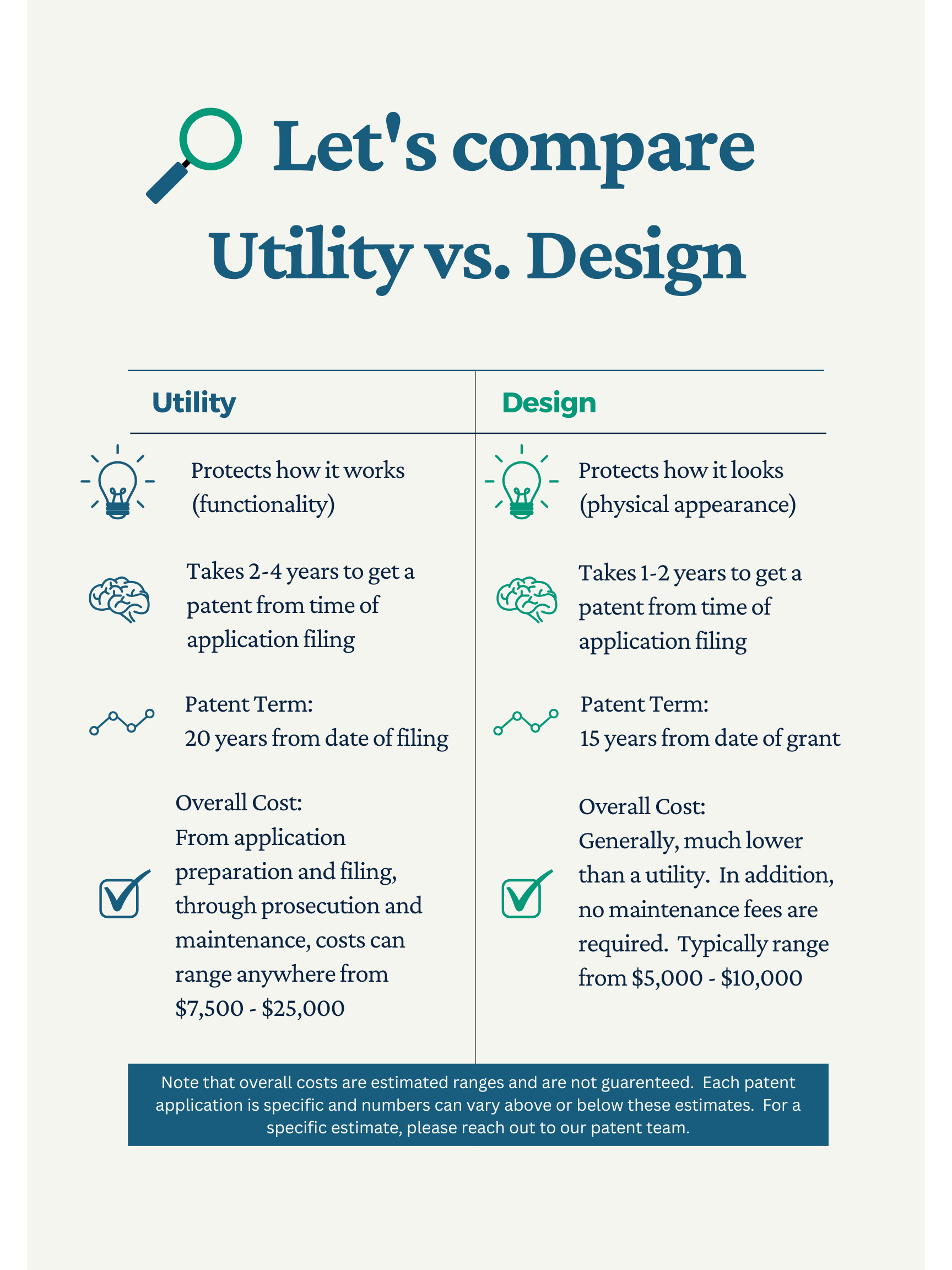
When considering whether to protect your invention using patent protection, it is important to first consider the type of patent to pursue. There are two types of patents that most of our clients apply for: Utility and Design. Both are described, and compared, briefly below. While the two types of patents may be sought for different reasons, we have many clients who choose to protect their invention by obtaining both types of patents.
Utility Patents
Utility patents are granted by the United States Patent and Trademark Office (USPTO) to anyone who invents or discovers a new and useful process, machine, article of manufacture, or composition of matter. In addition to protecting new items or processes, this type of patent can also protect improvements upon items or processes. Utility patents cannot be granted, however, to a new use for an already existing process, machine, article of manufacture, or composition of matter.
Design Patents
Design patents are granted to anyone who has invented a new, original ornamental design for an article of manufacture. The ornamental characteristics must be embodied in or applied to such an article. The subject matter may relate to the configuration or shape of an article, surface ornamentation applied to it, or the combination of both. A surface ornamentation design is inseparable from the article to which it is applied and cannot exist alone. It must be a definite pattern applied to an article of manufacture. The design patent protects only the appearance of an article, not its functional features.